- About
-
Solutions
-
Services
-
Biosciences
- PureDisc™ Enabled Membrane Protein Production
- Assay Development and Transfer
- Biochemistry / Enzymology
- Biomarker Services
- Biophysics
- Cell-Based Assays
- Compound screening and cascade design
- Cryo-EM
- Fibrosis Assays
- Project Management and Consultancy Services
- Protein Expression
- Structural Biology
- X-ray Crystallography
- Chemistry
- Integrated Drug Discovery
- Computer Aided Drug Design
- Hit ID and Screening Services
- DMPK Services
-
Biosciences
- Target Classes and Modalities
- Therapeutic Areas
-
A-Z
- A
- B
- C
- D
- E
- F
- G
- H
- I
- K
- L
- M
- N
- O
- P
- R
- S
- T
- V
- X
-
Services
- Library
- News & Events
- Careers

Mass Photometry
deep expertise • flexible solutions • close collaboration • rapid delivery
Principle of Operation
Mass photometry quantifies the interference between light reflected from a glass surface and light scattered by individual biomolecules transiently interacting with that surface.
The resulting contrast signal scales directly with molecular mass (Young et al., 2018), enabling accurate mass determination without labels or immobilization.
Applications
Protein State & Stability
- Oligomeric state determination (monomer → higher-order assemblies)
- Buffer and pH dependent stability profiling
- Assessment of stabilizing/destabilizing compound effects
Complex Formation
- Label-free detection of binary and ternary complexes, including those induced by bivalent compounds and molecular glues
- Quantification of compound-driven complex formation
- pH dependent complex formation analysis
- Stability-monitoring of biomolecular complexes
Antibody & Nucleic Acid Systems
- Fragmentation and aggregation analysis
- Antibody–antigen binding assessment
- Protein–nucleic acid complex characterization
Key Advantages
- Native, in solution measurements
- Label-free detection
- Sensitive to sample heterogeneity and purity
- Minimal sample consumption (100 pM–100 nM)
- Broad mass range: 30 kDa–5 MDa
- Time-resolved measurements for dynamic processes
- Suitable for oligomerization and complex formation studies
- Compatible with membrane proteins
- Rapid data acquisition and turnaround
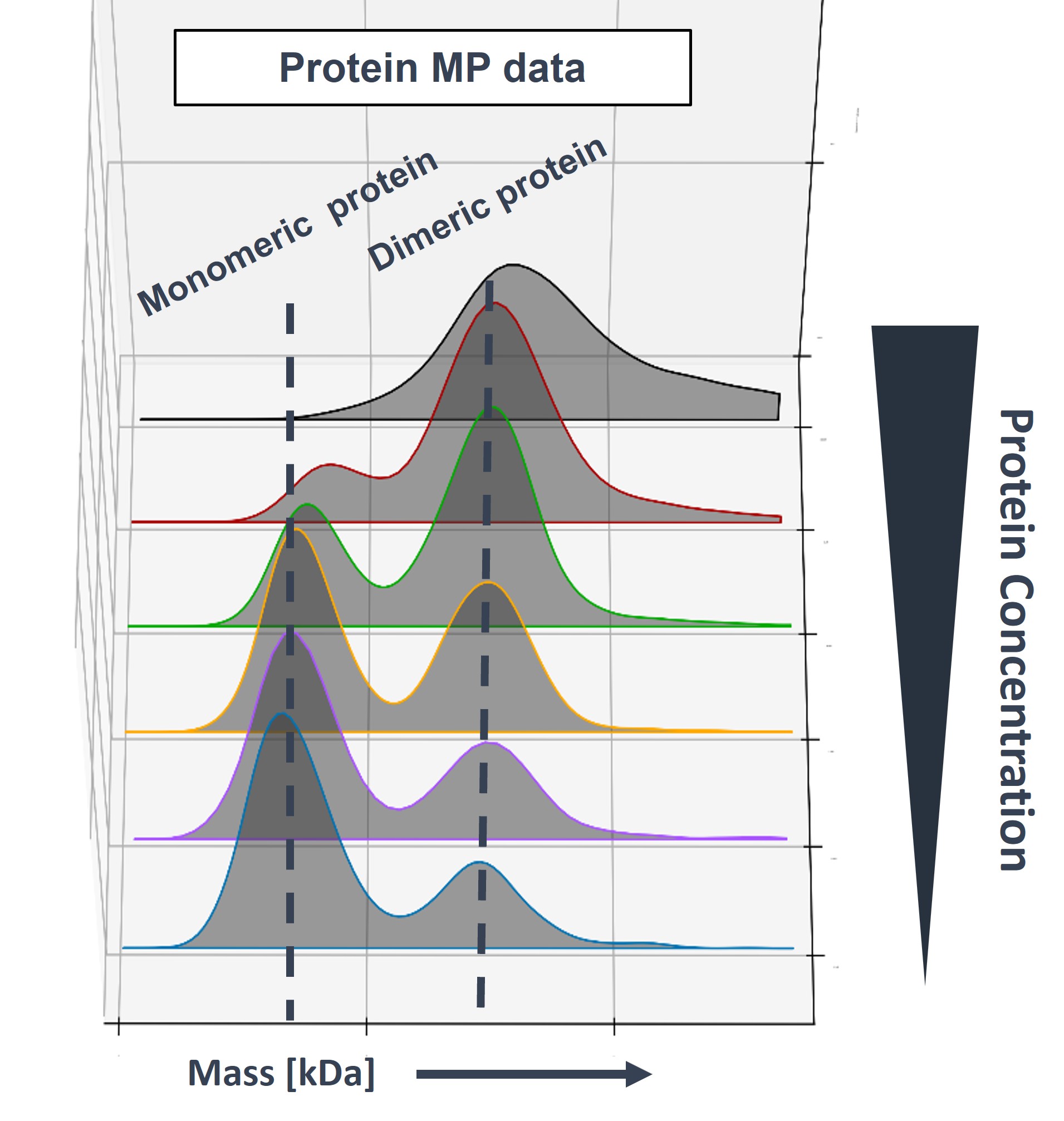
Example output showing protein dimer formation as concentration increases
Refeyn TwoMP
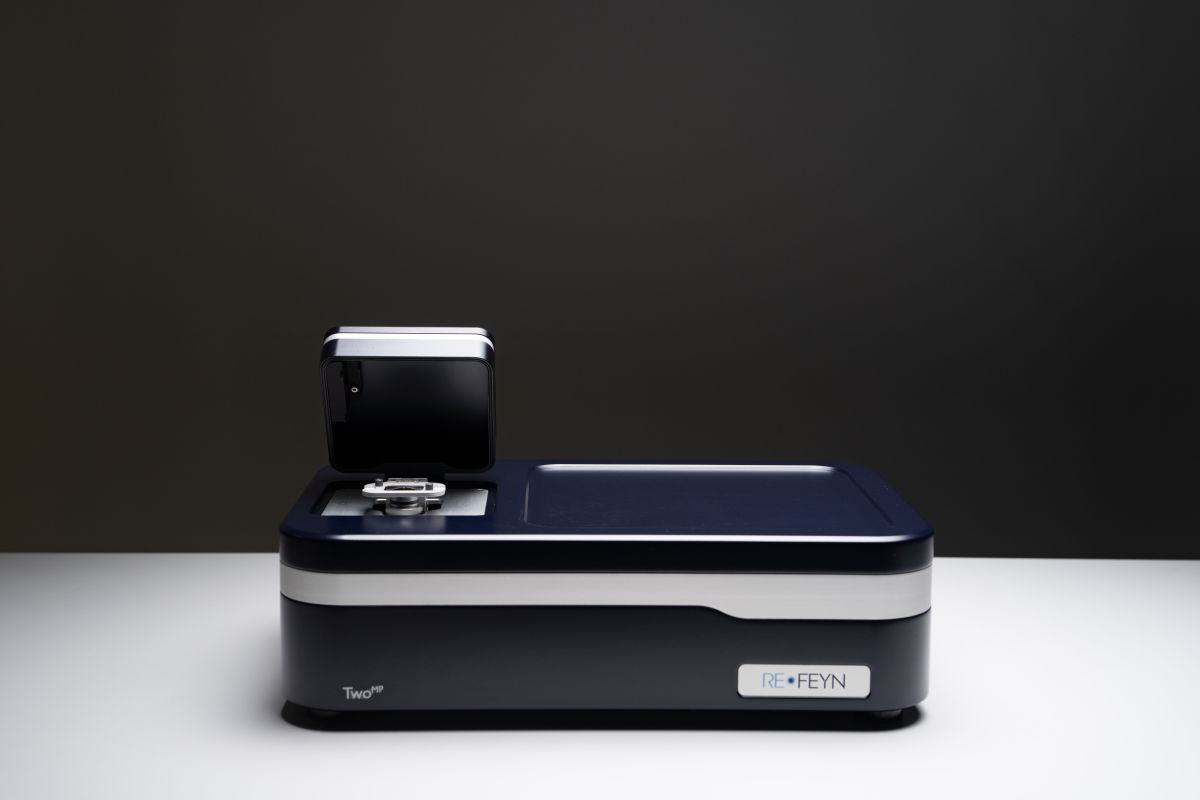
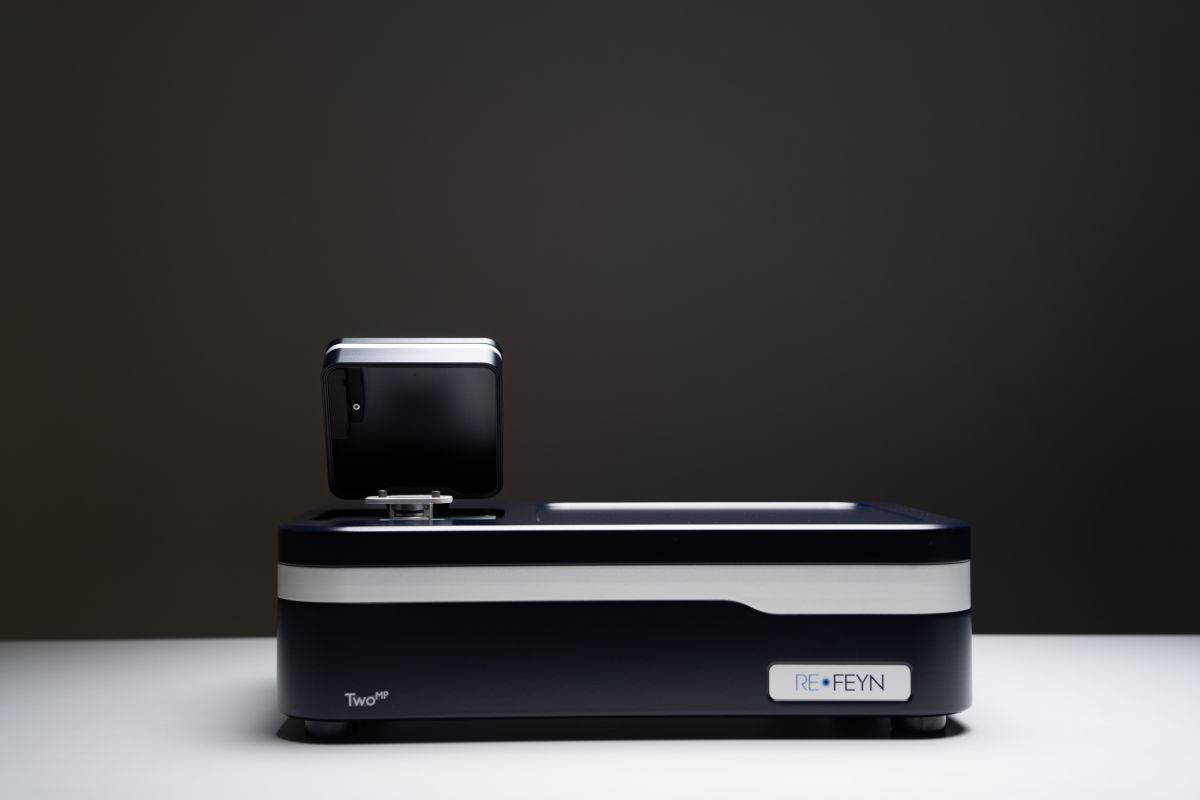
The TwoMP mass photometer measures the mass of single molecules in solution, enabling rapid characterization of proteins, antibodies, nucleic acids, and biomolecular interactions. Covering a broad mass range (30 kDa – 5 MDa) and consuming little sample, the TwoMP can report sample purity, protein binding and oligomerization, aggregation, mRNA length, and more. It works by quantifying interferometric light scattering.
Frequently Asked Questions
What is mass photometry (MP)?
Mass photometry is a label free, solution-based, single particle technique that measures the oligomeric state of individual biomolecules and particles by detecting the interference between light scattered by each particle and light reflected from a glass surface. The resulting contrast scales with molecular mass, allowing rapid determination of mass distributions and relative abundances without immobilization or tags.
How does Domainex use mass photometry for my drug discovery and biotherapeutics?
Domainex’s mass photometry service provides quick answers to questions about sample purity/heterogeneity, oligomeric state, complex stoichiometry, and binding. It also supports AAV and other viral vector analytics (e.g., empty/partial/full capsid proportions).
What kinds of samples can you run?
With current capabilities, Domainex scientists can run:
- Proteins and complexes (including antibodies), nucleic acids, protein–nucleic acid complexes, ribonucleoproteins, and small viruses (e.g., AAV). Typical measurable mass range is ~30–40 kDa up to ~5 MDa.
- MP can measure a wide range (pM to mM) of compound EC50/IC50 values if binding induces/disrupts complex formation or alters the oligomeric state of a protein
- For larger viral vectors (e.g., adenovirus), a related macro mass photometry mode measures size/contrast for particles in the ~40–150 nm range.
How does this integrate with other Domainex services?
Domainex scientists can use mass photometry as a standalone rapid measurement to determine the effect of therapeutics on oligomeric protein state or protein complexes. We also use this alongside biophysics/structural biology and screening to de-risk and aid these areas by verifying sample state, oligomerization, and complex formation before moving into assay development.
Can you use mass photometry to measure Ternary Complex Formation?
Mass photometry is a label-free in solution method for measuring ternary complex formation for both bivalent compounds as well as molecular glues. At Domainex we use Mass photometry as a complementary method alongside spectral shift, GCI and ITC
Is MP compatible with my buffer? Any components to avoid?
A wide-range of typical buffers are suitable for MP, however, results are sensitive to scattering background from buffer components. Therefore it is important to avoid detergents, especially at concentrations above CMC, and glycerol > ~2% . For any projects we will provide advice on sample preparation including buffer composition.
What is the turnaround time for mass photometry data at Domainex?
Domainex's data aquisition and automated analysis are completed within minutes per condition. As a result, data turnaround times are usually within a week of the request. To find out more, contact us through our enquiry form with your target and objectives. Our scientists will arrange a consultation to discuss project scope, feasibility, timelines, and recommended methods, ensuring a smooth and collaborative project launch.
Start your next project with Domainex
Contact one of our experts today