- About
-
Solutions
-
Services
-
Biosciences
- PureDisc™ Enabled Membrane Protein Production
- Assay Development and Transfer
- Biochemistry / Enzymology
- Biomarker Services
- Biophysics
- Cell-Based Assays
- Compound screening and cascade design
- Cryo-EM
- Fibrosis Assays
- Project Management and Consultancy Services
- Protein Expression
- Structural Biology
- X-ray Crystallography
- Chemistry
- Integrated Drug Discovery
- Computer Aided Drug Design
- Hit ID and Screening Services
- DMPK Services
-
Biosciences
- Target Classes and Modalities
- Therapeutic Areas
-
A-Z
- A
- B
- C
- D
- E
- F
- G
- H
- I
- K
- L
- M
- N
- O
- P
- R
- S
- T
- V
- X
-
Services
- Library
- News & Events
- Careers

Molecular Glue Drug Discovery Services
de-risked hits • validated mechanisms • integrated optimisation • rapid progression
Discover and de-risk molecular glue hits using Domainex’s integrated platform spanning protein science, assay development, fragment screening, biophysics, structural biology, medicinal chemistry and cellular pharmacology.
Whether stabilising native protein-protein interactions, inducing neo-interactions or developing molecular glue degraders, our teams rapidly design tailored programmes from target assessment and hit identification to mechanistic validation and lead optimisation.
By combining direct-to-biology screening, orthogonal validation, cooperativity and ternary complex expertise, cellular readouts and chemistry, we help clients make faster, confident decisions and progress the most promising molecular glue opportunities.
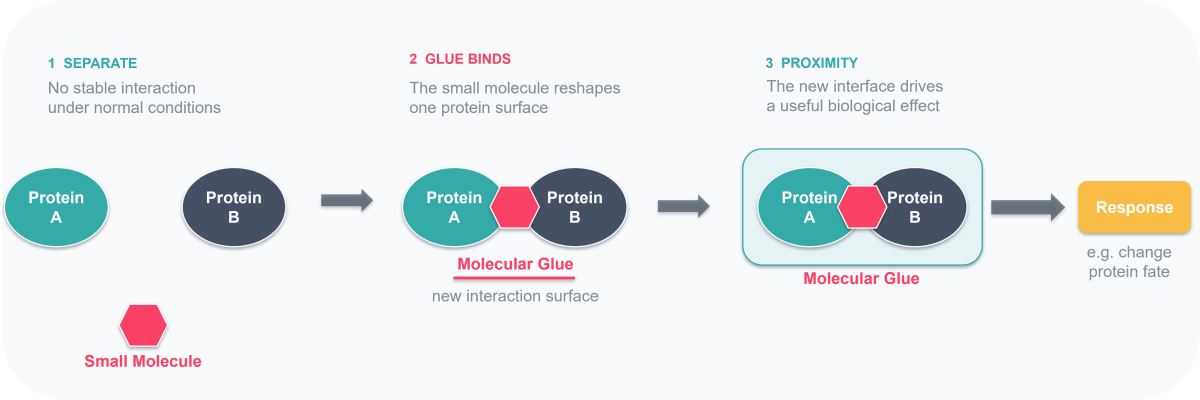
Molecular Glues: Small Molecules That Create New Protein Partnerships
A molecular glue works by making two proteins fit together: creating a productive interaction that would otherwise be weak or absent.
Why Molecular Glues Are Opening New Therapeutic Opportunities
Molecular glues are small molecules that stabilise existing protein-protein interactions or induce new ones, enabling proximity-driven pharmacology for targets that are difficult to address using conventional inhibitor approaches. Depending on the biology, molecular glues can drive degradation, stabilisation, sequestration, signalling modulation or functional rewiring of protein complexes.
Because molecular glues act through cooperative ternary complex formation, discovery programmes require assays that can detect weak binary interactions, enhanced protein proximity and downstream biological effects. Domainex combines screening, biophysics, structural biology and medicinal chemistry to help clients identify and optimise cooperative binders with clear mechanistic rationale.
Overcoming Common Molecular Glue Discovery Challenges:
- Weak or transient interactions
- False positives from proximity assays
- Difficulty determining cooperativity
- Uncertainty around binary versus ternary binding
- Deciding which hits are worth chemistry investment
Domainex addresses these challenges through orthogonal assay cascades that combine biochemical, biophysical, structural and cellular readouts, enabling clients to distinguish artefacts from genuine, optimisable molecular glue mechanisms.
Molecular Glue Discovery Workflow
Our molecular glue workflow is designed to identify promising hits early, confirm mechanism of action through orthogonal assays, and connect validated biology directly to medicinal chemistry optimisation:
Phase 1
Phase 2
Phase 3
Phase 4
Phase 5
Phase 6
Target Assessment and Feasibility
Biology review
Assay strategy
Timeline: 2–4 weeks
Protein Production
Expression and purification of targets
Timeline: 4–12 weeks
Assay Development
Biochemical, biophysical, and cellular assays optimised
Timeline: 4–10 weeks
Primary Screening
Fragment, focused library or HTS to find cooperative binders
Timeline: 4–8 weeks
Hit Validation
Orthogonal biophysics, ternary complex and counter‑screens
Timeline: 4–8 weeks
Structure and Optimisation
Structural biology, medchem cycles and cellular mechanism studies
Timeline: Variable
Phase 1 — Target Assessment and Feasibility
- Biology review
- Assay Strategy
- Timeline: 2–4 weeks
Phase 2 — Protein Production
- Expression and purification of targets
- Timeline: 4–12 weeks
Phase 3 — Assay Development
- Biochemical, biophysical and cellular assays optimised
- Timeline: 4–10 weeks
Phase 4 — Primary Screening
- Fragment, focused library or HTS
- Timeline: 4–8 weeks
Phase 5 — Hit Validation
- Orthogonal biophysics, ternary complex and counter screens
- Timeline: 4–8 weeks
Phase 6 — Structure and Optimisation
- Structural biology, MedChem cycles and mechanism studies
- Timeline: Project dependent
Why Partner with Domainex for Molecular Glue Discovery?
Domainex supports molecular glue discovery programmes from early target assessment through to validated hit series and optimisation. Our approach is tailored to each target system, mechanism and project stage, with flexible engagement models ranging from standalone assay support to integrated discovery campaigns.
- Expertise in challenging protein-protein interaction targets and induced proximity biology
- Fragment-based hit identification through FragmentBuilder® and complementary compound screening approaches
- Integrated protein science, biophysics, structural biology, medicinal chemistry and cellular assay teams
- Experience with E3 ligase systems including CRBN and VHL, alongside non-degradative molecular glue mechanisms
- Orthogonal assay cascades to confirm ternary complex formation, cooperativity and mechanism of action
- Flexible project models designed around client objectives, timelines and decision points
Case Study: Confirming Molecular Glue-Induced Ternary Complex Formation
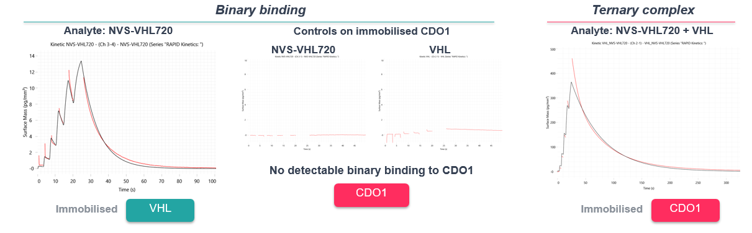
- Challenge: Distinguishing binary binding from productive ternary complex formation
- Approach: Grating-Coupled Interferometry was used to measure binary and ternary binding kinetics of NVS-VHL720, a molecular glue for VHL and CDO1
- Outcome: NVS-VHL720 showed direct VHL binding and compound-dependent formation of a measurable VHL–CDO1 ternary complex
- Why it matters: This demonstrates how orthogonal biophysics can confirm mechanism of action and prioritise hits for optimisation
Molecular Glues Beyond Targeted Degradation
While molecular glue degraders have attracted significant attention, induced proximity can support a much broader range of biology. Molecular glues may stabilise beneficial PPIs, induce novel protein-protein interactions, modulate signalling complexes, remodel transcriptional machinery, recruit accessory proteins to disease targets or alter protein trafficking and localisation.
Applicable Target Classes
- Transcription factors and transcriptional regulators
- Scaffold and adaptor proteins
- Regulatory proteins with limited ligandable pockets
- Challenging PPI targets
- Oncology, inflammation and CNS-relevant targets
- Protein complexes where stabilisation, sequestration or induced proximity may provide therapeutic benefit
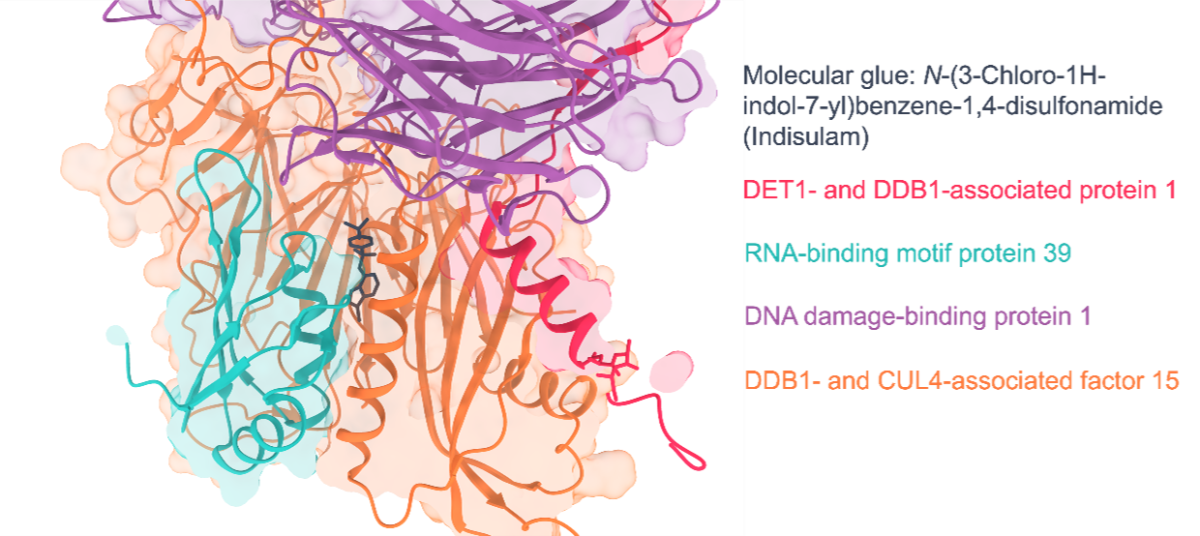
Assay Technologies to Detect, Validate and Optimise Molecular Glues
- Screening: FragmentBuilder®, focused compound libraries, HTS-compatible biochemical assays, AlphaScreen and fluorescence-based proximity assays
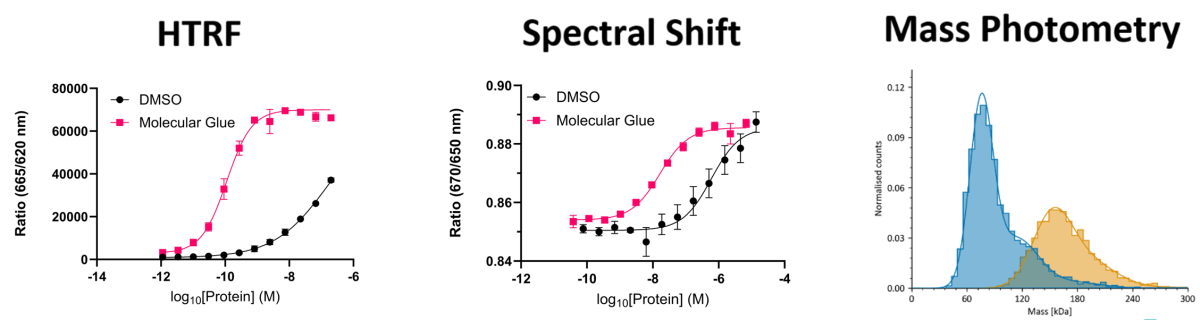
- Weak interaction detection: Spectral Shift/MST approaches to detect and quantify weak binary interactions and compound-enhanced cooperativity
- Biophysical validation: SPR, GCI, ITC and mass photometry to assess binding kinetics, stoichiometry and ternary complex formation
- Structural biology: X-ray crystallography and cryo-EM to define molecular interfaces and guide structure-based optimisation
- Cellular pharmacology: HiBiT degradation assays, automated western blotting, pathway modulation assays and mechanistic profiling
Planning a Molecular Glue Discovery Programme?
Whether you are evaluating a novel target, seeking screening support or looking for a fully integrated discovery campaign, Domainex scientists can help design the optimal strategy for your molecular glue programme.
Frequently Asked Questions
What is a molecular glue?
Molecular glues are small molecules that either stabilise an existing protein-protein interaction or induce a new interaction between two proteins. By promoting the formation of a protein complex, they can modulate biological pathways that may be difficult to address using conventional small-molecule approaches.
How do molecular glues differ from PROTACs®?
Although both approaches can be used for targeted protein degradation, molecular glues are typically single, low-molecular-weight compounds that induce highly cooperative interactions between proteins. In contrast, PROTACs® are larger bifunctional molecules containing two ligands connected by a linker. The smaller size of molecular glues can offer advantages in terms of physicochemical properties, synthesis, and potential oral or CNS exposure.
Can molecular glues target "undruggable" proteins?
Yes. Molecular glues can enable the modulation of proteins that lack conventional small-molecule binding pockets by inducing or stabilising protein-protein interactions. This creates opportunities to address challenging targets that may not be accessible through traditional drug discovery approaches.
Do molecular glues require a pre-existing protein–protein interaction?
Not necessarily. Molecular glues can either stabilise an existing protein–protein interaction, including very weak or transient interactions, or induce a new interaction between proteins that would not normally associate strongly under physiological conditions. In many discovery programmes, the objective is to identify compounds that enhance the cooperativity of a weak interaction, effectively increasing ternary complex formation and driving the desired biological outcome.
How are molecular glues discovered if the proteins interact only weakly?
Many molecular glue discovery programmes focus on identifying compounds that increase the cooperativity of weak or transient protein-protein interactions. Domainex uses screening platforms such as Spectral Shift (MST), HTRF, AlphaScreen, SPR, GCI and Mass Photometry to detect and characterise these compound-induced ternary complexes.
What types of molecular glue projects does Domainex support?
Domainex supports the full discovery cycle, including hit identification, hit validation, mechanism-of-action studies, medicinal chemistry optimisation, structural biology, biophysical characterisation, and cellular assay development. Project strategies are tailored to the scientific objectives of each client programme.
How does Domainex identify novel molecular glue hits?
We use a range of hit finding approaches, including fragment-based, virtual, and high throughput screening. Spectral Shift (MST), AlphaScreen, and other biochemical or biophysical assays are developed to detect cooperative ternary complex formation. These platforms can be adapted to the specific biology and target pair involved in the project.
Which biophysical techniques are available for molecular glue characterisation?
Domainex routinely employs orthogonal biophysical methods including Grating-Coupled Interferometry (GCI), Surface Plasmon Resonance (SPR), Mass Photometry, and other complementary technologies to characterise binding affinity, kinetics, cooperativity, and ternary complex formation.
Can Domainex provide structural biology support for molecular glue programmes?
Yes. Structural insights are often critical for understanding molecular glue mechanisms and guiding optimisation. Domainex offers X-ray crystallography and cryo-EM capabilities to determine ternary complex structures and support structure-based drug design. Domainex also can access HDX-MS which can be employed if the other structural methods are not suitable.
Do you have experience with E3 ligases?
Yes. Domainex's protein science team has extensive experience producing and characterising E3 ligases, and we maintain in-house capability with commonly used ligases such as VHL and Cereblon to accelerate project initiation.
Can Domainex evaluate molecular glues in cellular systems?
Absolutely. We routinely conduct cell-based studies, including HiBiT degradation assays, automated Western blotting, and other cellular approaches to confirm target engagement, degradation, and biological activity in relevant cellular models.
What information is needed to start a molecular glue discovery project?
The optimal starting point varies by project. We can work with a validated target, an existing biological hypothesis, a known protein-protein interaction, or a targeted protein degradation concept. Our scientists will work with you to define the most appropriate discovery strategy based on your objectives and available data.
Why choose Domainex for molecular glue drug discovery?
Domainex combines expertise in molecular glues, targeted protein degradation, fragment-based discovery, medicinal chemistry, protein sciences, structural biology, biophysics, and cell biology. This integrated capability enables rapid progression from hit identification through to validated lead compounds using a coordinated workflow.
What is the difference between a molecular glue and a molecular glue degrader?
A molecular glue modifies or stabilises a protein-protein interaction. A molecular glue degrader is a specific type of molecular glue that recruits an E3 ligase to a target protein, ultimately leading to ubiquitination and degradation of the target.
What assays are used to discover molecular glues?
Common assays include AlphaScreen, MST/Spectral Shift, SPR, GCI, mass photometry, cellular degradation assays, and structural biology techniques such as cryo-EM and X-ray crystallography. These complementary approaches help identify, validate, and optimise molecular glue compounds.
Start your next project with Domainex
Contact one of our experts today