- About
-
Solutions
-
Services
-
Biosciences
- PureDisc™ Enabled Membrane Protein Production
- Assay Development and Transfer
- Biochemistry / Enzymology
- Biomarker Services
- Biophysics
- Cell-Based Assays
- Compound screening and cascade design
- Cryo-EM
- Fibrosis Assays
- Project Management and Consultancy Services
- Protein Expression
- Structural Biology
- X-ray Crystallography
- Chemistry
- Integrated Drug Discovery
- Computer Aided Drug Design
- Hit ID and Screening Services
- DMPK Services
-
Biosciences
- Target Classes and Modalities
- Therapeutic Areas
-
A-Z
- A
- B
- C
- D
- E
- F
- G
- H
- I
- K
- L
- M
- N
- O
- P
- R
- S
- T
- V
- X
-
Services
- Library
- News & Events
- Careers

Grating-Coupled Interferometry (GCI) and Surface Plasmon Resonance (SPR)
deep expertise • flexible solutions • close collaboration • rapid delivery
Domainex has invested in the Creoptix WAVEdelta platform which uses the biophysical technique of Grating-Coupled Interferometry (GCI). GCI is analogous to Surface Plasmon Resonance (SPR). In both techniques, the target protein is immobilised onto specialised sensor chips and the passage of analytes over the chip surface are monitored as time-dependent changes in refractive index, which can indicate bi-molecular interactions.
Technology at Domainex
Grating Coupled Interferometry (GCI) and Surface Plasmon Resonance (SPR) are techniques that detects how two molecules bind in real time by measuring tiny changes in refractive index that are obtained from mass changes near the sensor surface when a bi-molecular interaction occurs.
GCI vs SPR
Where GCI and SPR differ is that SPR detect a localised area of the chip surface whereas GCI samples the entire chip surface. GCI is therefore able to detect more binding events which enhances its sensitivity relative to SPR. Additionally, because the evanescent field does not penetrate as deep into the sample with GCI, there is less disturbance by bulk refractive index changes. GCI technology has proven application in fragment screening and to support subsequent hit-to-lead and lead optimisation stages of drug discovery. As the assay is label-free, homogenous, flow-based and kinetically read, it is ideally suited to measuring compound binding kinetics. The sensitivity and versatility of the WAVE system enables a wide variety of matrices to be used.
Innovative novel fluidics
The no-clog microfluidics support large particles and are compatible with a wide variety of fluids such as:
- Crude reaction mixtures, high concentrations of DMSO and uncommon organic solvents
- 100% serum and plasma
- Cell supernatants
- Cell membrane preparations, PureDiscTM/SMALP, nanodisc and detergent solubilised membrane proteins
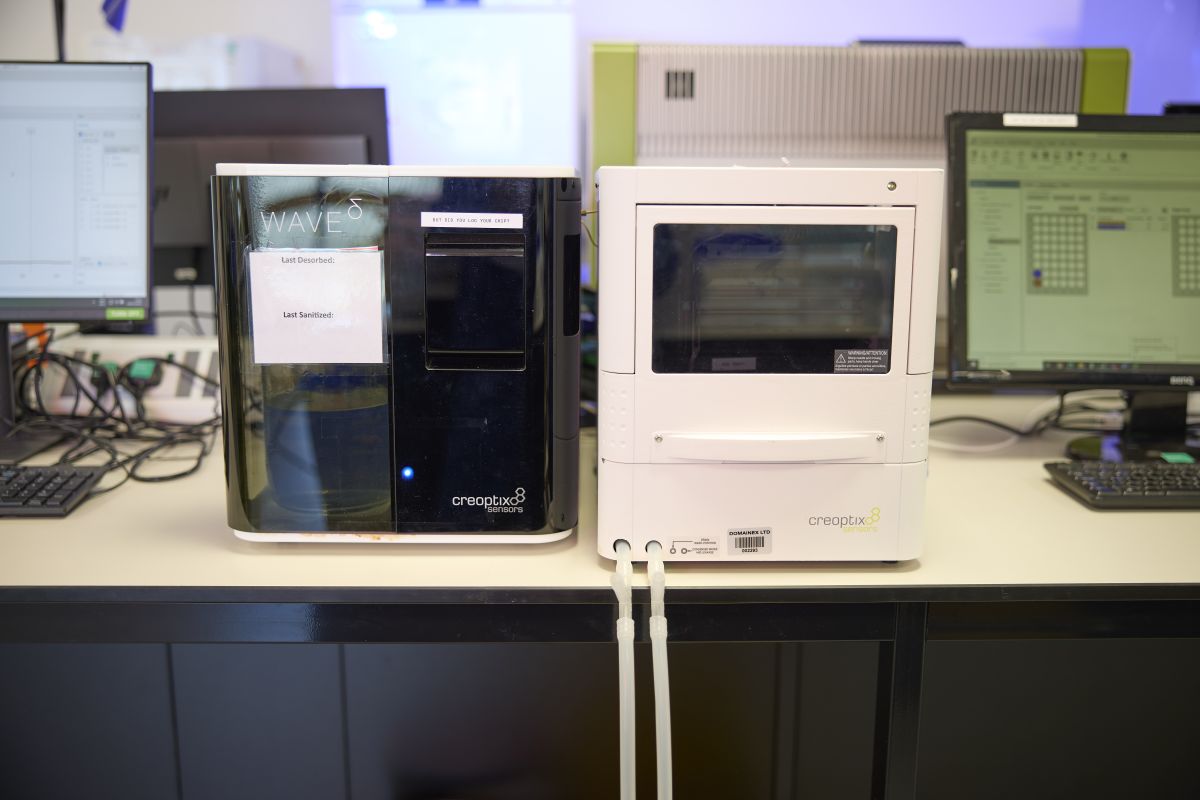
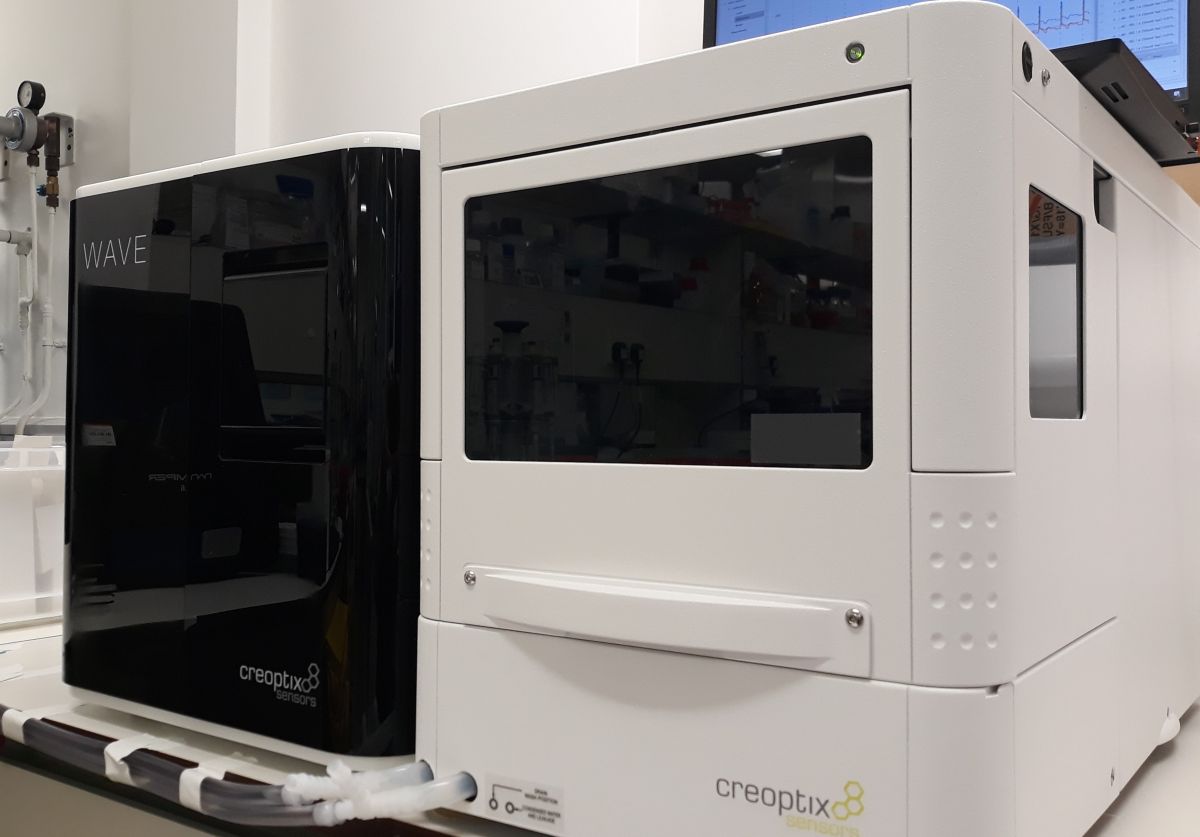
Key advantages of the WAVEdelta system
- More sensitive than SPR
- Varied pulse duration to minimise cycle time (waveRAPID® technology), increase throughput and also to allow compound titrations in one run
- Extra channel opens up the possibility of running a reference or selectivity protein in parallel to the test protein as part of the same run
- Fast and accurate measurements of kinetic rates
- Accurate determination of dissociation rates of up to 10 sec-1 – useful for studying weak binders such as fragments
- “Clog-free” and therefore suitable for analysing plasma, serum and crude cell lysates
If you would like to access Domainex’s ligand binding assay services to support your programme of research, we would be delighted to hear from you.
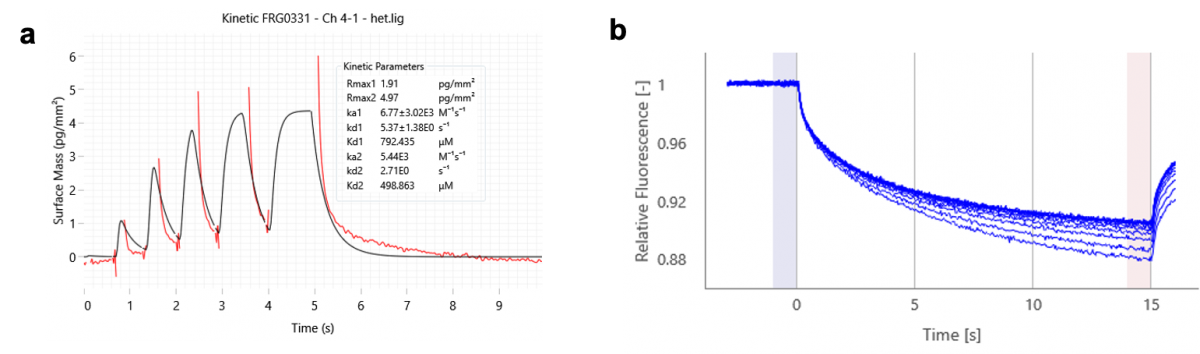
Figure 1: a) waveRAPID kinetic data obtained using the Creoptix WAVEdelta system for G9a fragment hit, Frg331. A KD value of 499 µM was obtained. B) Microscale Thermophoresis (MST) data for the same fragment hit. A KD value of 460 µM was obtained using this technique.
Applications of GCI/SPR
1. Fragment Screening & Hit Identification
GCI/SPR is a standard technique for screening fragment libraries and identifying weak binders during early discovery. It can detect low‑affinity interactions and provide kinetic information crucial for prioritising fragments.
2. Hit Validation & Orthogonal Confirmation
After initial hits are found (for example from HTS or virtual screening), GCI/SPR serve as an orthogonal assay to:
- Confirm direct binding
- Eliminate false positives
- Characterise binding specificity
3. Lead Optimisation
Kinetic profiling helps guide structure‑activity relationship (SAR) efforts by providing:
- Association and dissociation rate constants (ka, kd)
- Residence time
- Affinity improvements across analogues
4. Antibody Discovery & Characterisation
GCI/SPR is heavily used for biologics, especially antibodies, enabling:
- Affinity ranking
- Epitope binning/mapping
- Cross‑reactivity testing
- FcRn and FcγR receptor profiling (pH dependency, specificity)
5. Mechanistic and Structural Interaction Analysis
GCI/SPR supports deeper mechanistic understanding by providing:
- Binding stoichiometry
- Competition assays
- Ternary complex formation studies (e.g., PROTAC cooperativity)
6. Protein–Protein, Protein–RNA, and Other Complex Interaction Studies
GCI/SPR is heavily used for biologics, especially antibodies, enabling:
- Protein–protein interactions
- RNA binders
- Peptide interactions
- Oligonucleotide interactions
Testimonials:
Senior Principal Scientist, (US-based Biotech company)
Domainex has been an outstanding partner over the past two years, supporting multiple discovery programs through their biophysics GCI platform. Their rapid method development, fast turnaround times, and willingness to adapt screening strategies to evolving project needs enabled us to make timely, data-driven decisions and advance our programs efficiently. The team consistently demonstrated scientific excellence and a collaborative mindset, making them a trusted extension of our internal research team.
Frequently Asked Questions
Does Domainex do SPR?
Yes, Domainex have an agreement with The University of Cambridge which allows us access to a Biacore T200, a firm favourite used in drug discovery.
Domainex also offers GCI, which is analogous to Surface Plasmon Resonance (SPR). In both techniques, the target protein is immobilised onto specialised sensor chips and the passage of analytes over the chip surface is monitored as time‑dependent changes in refractive index, which can indicate bi‑molecular interactions.
Is the assay label-free?
Yes. SPR and GCI assays using the WAVEdelta platform are label‑free, homogeneous, flow‑based, and kinetically read, making them ideal for determining quantitative binding kinetics.
Why are label‑free techniques important?
Domainex's GCI assays are label free and preserve the natural behaviour of your molecules. Absence of fluorescent or radioactive tagging means interactions are measured as they occur, producing highly reliable kinetic data.
Can you work with challenging targets or complex samples?
Yes. The team at Domainex has extensive experience with difficult proteins, low‑affinity binders, membrane‑associated targets, multi‑domain constructs, fragments, and chemically diverse small molecules. We also provide support for assay development, buffer optimisation, and protein engineering to ensure high‑quality data.
Do you offer high‑throughput or rapid‑turnaround biophysics?
Domainex provides rapid screening for early triage, hit validation, and fragment expansion. For time‑critical projects, we offer accelerated timelines while maintaining data robustness and scientific integrity.
How can proteins be immobilised?
Most immobilisation strategies at Domainex commonly used for SPR can be used also for GCI. Amine-coupling, Capture-coupling, Ni-NTA-coupling, Streptavidin capture and Neutravidin capture are all possible. Alternative immobilisation strategies may have to be considered depending upon the individual protein characteristics.
Can GCI/SPR help confirm hit validity?
Absolutely. These techniques are widely used by Domainex to confirm direct target engagement and eliminate false positives from screening campaigns through real‑time binding verification.
Which affinity parameters can be determined at Domainex?
- Binding enthalpy, ΔH. KD values at different temperatures can be used to obtain the binding enthalpy of an interaction via van't-Hoff-plots.
- KD Equilibrium dissociation constant. Can be obtained by kinetic or classical equilibrium binding analysis. Provides information about the strength but not the dynamics of an interaction.
Which kinetic parameters can be determined?
- Association rate constant, kon (ka) . Provides information on how fast complexes form; can be used for KD determination
- Dissociation rate constant, koff (kd). Provides information on how fast complexes dissociate; can be used for KD determination
- Equilibrium dissociation constant, KD. Can be obtained by kinetic or classical equilibrium binding analysis. Provides information about the strength but not the dynamics of an interaction
Which kinetic models does Domainex use for data analysis?
Domainex scientists use predefined models including 1:1 interaction, mass transport, heterogenous ligand, conformational change and bivalent interactions
What are the measurement limitations of a GCI assay at Domainex?
| Measurement | Wavedelta Limitation |
|---|---|
| Association Constant Range | Small molecules: ka = 103 – 5x10⁷ M-1 s–1 |
| Large molecules: ka = 103 – 3x10⁹ M-1 s–1 | |
| Dissociation Constant Range | kd = 10–6 – 10 s–1 |
| Temperature range | 4 °C – 45 °C (max 20 °C below ambient) |
What throughput can I expect?
With waveRAPID® analysis mode Domainex can run entire fragment screens quickly, reducing cycle times and enabling higher‑throughput interaction profiling. The waveRAPID® analysis mode can easily be up to 5 times faster than conventional SPR.
Do you provide data interpretation?
Yes, Domainex scientists provide full kinetic analysis, hit triage support, and guidance on how binding behaviour informs medicinal chemistry or biological follow‑up.
What data outputs will I receive?
Domainex will provide:
- Raw data files
- Curated, analysed datasets
- Binding curves, kinetic fits, and thermodynamic summaries
- Clear interpretation and biological context
- Recommendations for next steps
Can Domainex support integrated drug discovery programmes?
The biophysics team at Domainex supports integrated drug discovery programs by working seamlessly with internal medicinal chemistry, structural biology, computational chemistry, and screening groups. This integrated model ensures that biophysical insights directly inform hit identification, hit‑to‑lead progression, and lead optimisation.
How do I start a project or discuss feasibility?
Contact Domainex through our enquiry form with your target and objectives. Our scientists will arrange a consultation to discuss project scope, feasibility, timelines, and recommended methods, ensuring a smooth and collaborative project launch.
Start your next project with Domainex
Contact one of our experts today