- About
-
Solutions
-
Services
-
Biosciences
- PureDisc™ Enabled Membrane Protein Production
- Assay Development and Transfer
- Biochemistry / Enzymology
- Biomarker Services
- Biophysics
- Cell-Based Assays
- Compound screening and cascade design
- Cryo-EM
- Fibrosis Assays
- Project Management and Consultancy Services
- Protein Expression
- Structural Biology
- X-ray Crystallography
- Chemistry
- Integrated Drug Discovery
- Computer Aided Drug Design
- Hit ID and Screening Services
- DMPK Services
-
Biosciences
- Target Classes and Modalities
- Therapeutic Areas
-
A-Z
- A
- B
- C
- D
- E
- F
- G
- H
- I
- K
- L
- M
- N
- O
- P
- R
- S
- T
- V
- X
-
Services
- Library
- News & Events
- Careers

PureDisc™ Enabled Membrane Protein Production
deep expertise • flexible solutions • close collaboration • rapid delivery
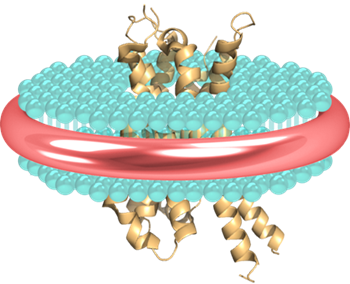
Detergent‑free. Native state. Ready for biophysics and structural biology.
Maintaining membrane proteins in a native phospholipid environment is often essential for correct folding, stability, and biological function. Traditional detergent‑based approaches can disrupt critical lipid–protein interactions, leading to loss of native conformation and poor downstream performance.
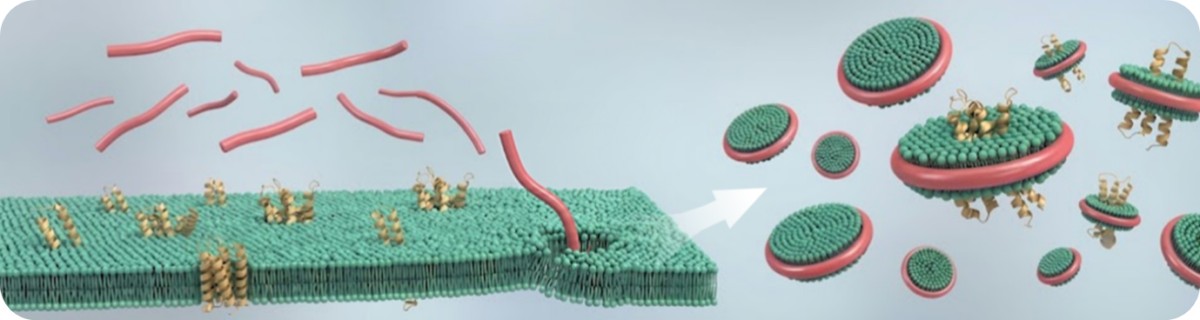
Nanodiscs enable purification of membrane proteins within a defined phospholipid bilayer, preserving native lipid interactions and delivering proteins suitable for biophysics, structural biology, and biologics discovery.
Domainex Nanodisc Capability
The Domainex proprietary PureDiscTM platform overcomes the key expression and stability challenges associated with membrane protein production in nanodiscs, delivering native, stable, monodisperse membrane proteins ready for discovery workflows.
Key capabilities: Nanodisc membrane protein production · GPCRs and ion channels · Detergent‑free biophysics · Cryo‑EM‑ready protein · Antibody discovery antigens
What We Provide at Domainex
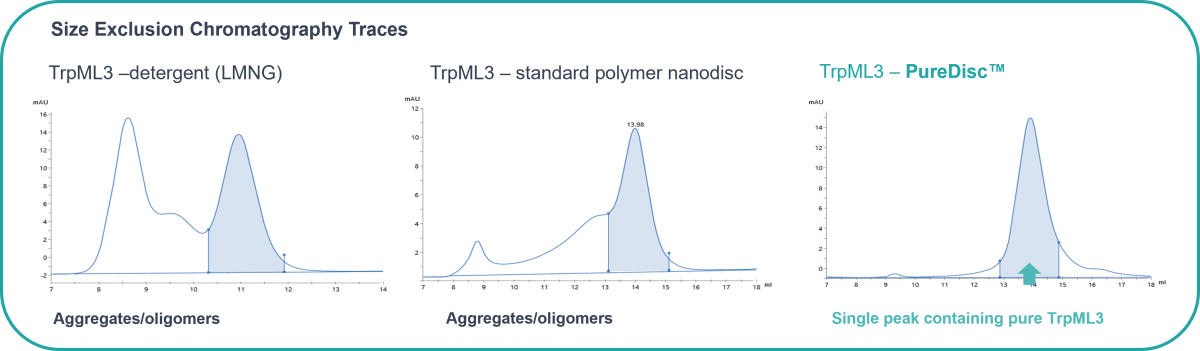
High quality, monodisperse membrane proteins
SEC-purified preparations that retain their native lipid environment and are fully compatible with biophysical and structural biology assays.
Enhanced expression of wild‑type membrane proteins
Traditional approaches often rely on stabilizing mutations or extensive construct engineering. The Domainex PureDisc™ system enables high‑yield expression of wild‑type targets, validated by native‑fold quality control.
Rapid and robust solubilization workflows
Optimized nanodisc platforms using a range of amphipathic polymers deliver efficient, reproducible solubilization across multiple membrane protein classes.
Rigorous QC and expert scientific support
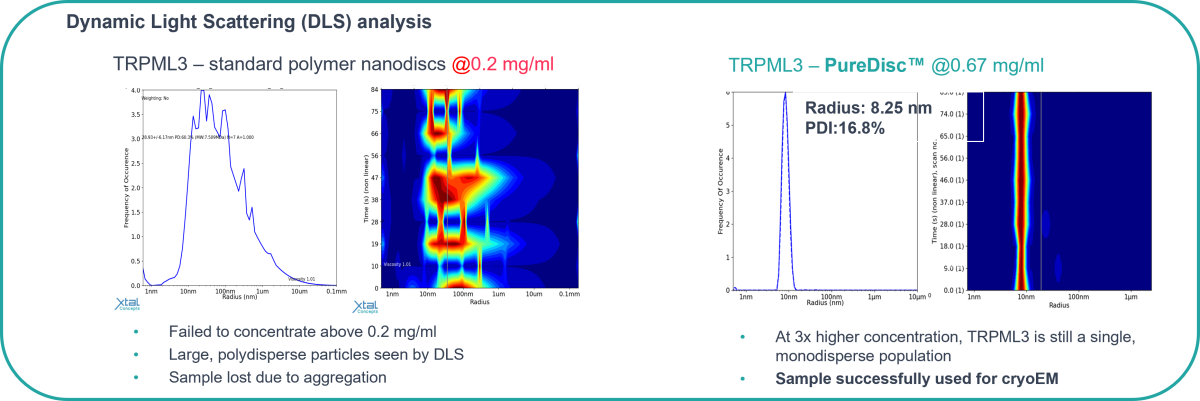
Proteins are supplied at high concentration (>0.5 mg/mL), with thermal stability and homogeneity suitable for in‑house biophysics, cryo‑EM, and structural studies.
Biophysics on PureDiscTM‑Purified Proteins
Domainex generates binding affinity and kinetic data for small molecules and biologics using nanodisc‑embedded membrane proteins across multiple biophysical platforms, including:
- Spectral Shift assays
- Grating‑Coupled Interferometry (GCI / SPR‑equivalent)
- NanoDSF thermostability profiling
These approaches support lead identification, hit validation, and epitope characterisation.

Structural Biology
We deliver highly pure, monodisperse nanodisc preparations suitable for cryo‑EM. Our case studies demonstrate the generation of high‑resolution cryo‑EM structures.
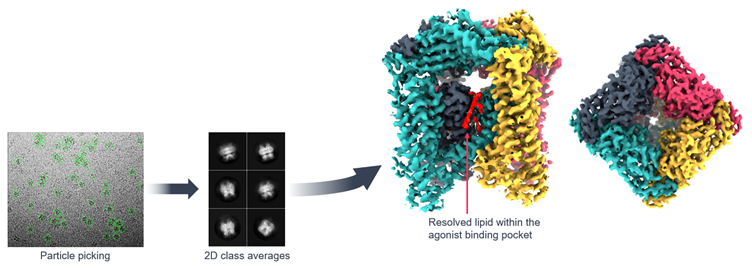
Cryo-EM structures of Apo TrpML3 in polymer nanodiscs
Applications
Antibody Discovery
Natively folded membrane protein antigens for immunisation, display, or selection
Hit Identification
Fragment and small‑molecule screening on challenging targets including GPCRs and ion channels
Biophysics
Affinity, kinetics, stoichiometry, competition, and epitope mapping
Structural Biology
Cryo‑EM and X‑ray crystallography
Frequently Asked Questions
What are nanodiscs used for in membrane protein research?
Nanodiscs are used to stabilise membrane proteins in a native phospholipid bilayer, enabling detergent free studies of membrane protein structure, function, and ligand binding in biophysics and structural biology.
Why are nanodiscs better than detergents for membrane proteins?
Detergents can disrupt lipid-protein interactions and destabilise membrane proteins. Nanodiscs preserve the native lipid environment, helping maintain correct folding, stability, and biological activity.
What types of membrane proteins can be produced in nanodiscs?
Nanodiscs are suitable for a wide range of targets including GPCRs, ion channels, transporters, and other transmembrane proteins that are challenging to study using detergent based approaches.
Can Domainex work with challenging targets or complex samples?
Yes. The team at Domainex has extensive experience with difficult proteins, low‑affinity binders, membrane‑associated targets, multi‑domain constructs, fragments, and chemically diverse small molecules. We also provide support for assay development, buffer optimisation, and protein engineering to ensure high‑quality data.
Does Domainex provide wild type membrane proteins in nanodiscs?
Yes. The Domainex proprietary PureDisc™ platform enables high yield expression of wild type membrane proteins, often without the need for stabilising mutations or extensive construct engineering.
Are nanodisc proteins compatible with biophysical assays?
Yes. Domainex nanodisc purified membrane proteins are compatible with SPR/GCI, spectral shift assays, NanoDSF, and other biophysical techniques for measuring affinity, kinetics, and stability.
Can nanodisc membrane proteins be used for cryo EM?
Yes. Domainex supplies highly pure, monodisperse nanodisc preparations suitable for cryo EM, and has demonstrated high resolution structures including ligand and small molecule binding.
What protein concentrations are achievable with nanodiscs?
Domainex typically supplies nanodisc embedded membrane proteins at concentrations exceeding 0.5 mg/mL, suitable for demanding biophysics and structural biology workflows.
How are nanodisc membrane proteins quality controlled?
Proteins undergo size exclusion chromatography, thermal stability assessment, and native fold QC to confirm monodispersity, stability, and suitability for downstream applications.
Can nanodisc proteins be used for antibody discovery?
Yes. Nanodiscs provide natively folded membrane protein antigens suitable for immunisation, selection, and epitope mapping in antibody discovery programmes.
Does Domainex offer biophysics and structural biology support?
Yes. Domainex provides end-to-end support, from nanodisc protein production through to biophysical characterization and cryo EM structural biology.
How do I start a project or discuss feasibility?
Contact Domainex through our enquiry form with your target and objectives. Our scientists will arrange a consultation to discuss project scope, feasibility, timelines, and recommended methods, ensuring a smooth and collaborative project launch.
Start your next project with Domainex
Contact one of our experts today