
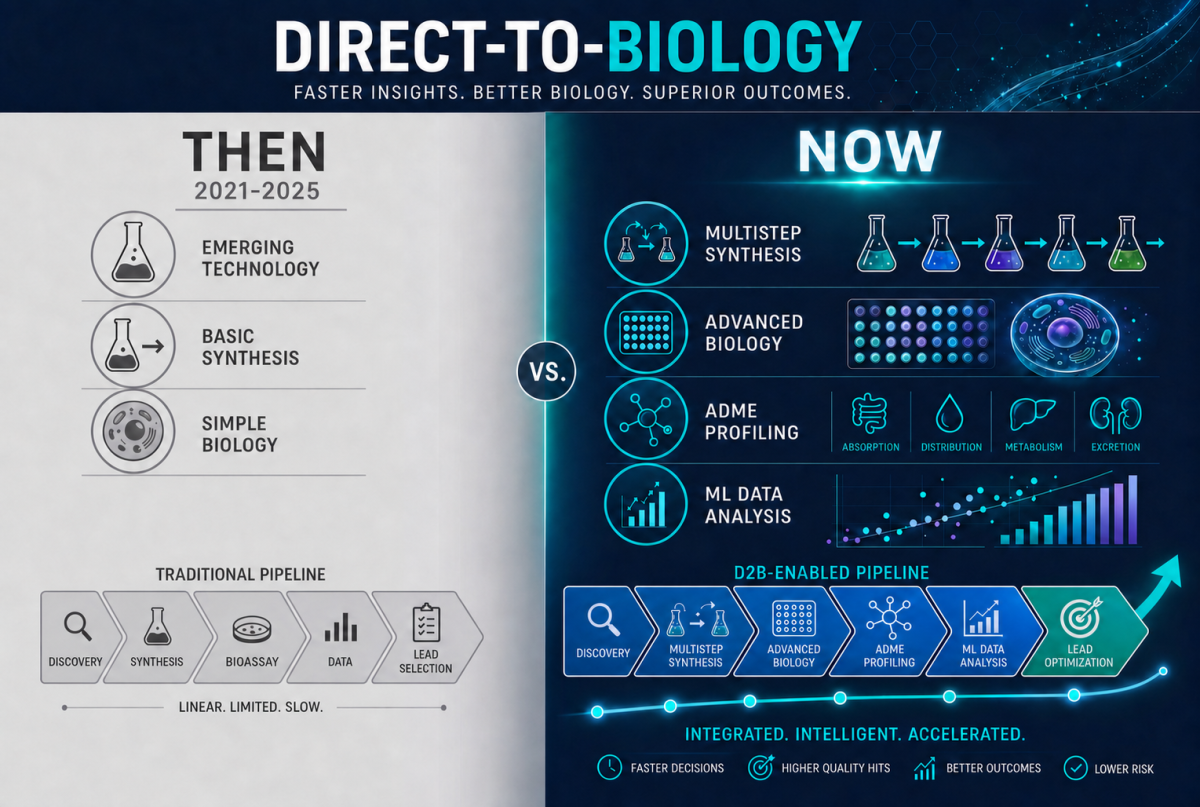
In early 2025, we asked a simple question: "D2B or not D2B?"1
From the published literature to 2025 much of the disclosed campaigns and platforms centred on PROTAC® hit finding and covalent drug discovery space, with amide formation being the most common reaction executed. The promise was compelling: synthesise compounds at nanomole scale, test crude reaction mixtures directly in biological assays, and remove one of medicinal chemistry's most persistent bottlenecks – purification. More evidence was needed to demonstrate that reliable project decisions could be made using data generated from crude samples.2
Fast forward to mid-2026 and the conversation has changed. With biotech and big pharma beginning to incorporate D2B more and more mainstream drug discovery programmes, the question is no longer whether D2B has a role in drug discovery, but rather, at what stage can D2B can have the greatest impact within a modern drug discovery programme?
D2B is No Longer a Proof of Concept
The first generation of D2B publications focused on demonstrating feasibility. Researchers needed to show that crude reaction mixtures could generate meaningful biological data, that assay interference could be managed and that D2B-derived hits would translate into genuine medicinal chemistry progress.1,2
The recent literature looks quite different. Scientists are now using D2B routinely to discover kinase inhibitors, antiviral agents, covalent ligands, PROTACs and molecular glues across a wide range of therapeutic areas. A 2026 ChemMedChem review by Hübner identified 44 D2B campaigns spanning multiple targets, modalities and assay formats, with publication output increasing rapidly since the approach was first formalised.2
D2B has moved beyond proof-of-concept and is becoming part of the infrastructure of modern drug discovery.
From Removing Bottlenecks to Accelerated Decision Making
The original attraction of D2B was to eliminate purification and save time and money. While that benefit remains important, the true value of D2B increasingly lies elsewhere.
Generating ideas in drug discovery is now easier than ever. Computational chemistry, virtual screening, structure-based design and more recently, generative AI can produce thousands, or even millions of hypotheses. The real challenge is determining which ones deserve experimental investment.2
D2B addresses this problem by accelerating experimental learning. Instead of spending weeks synthesising, purifying and characterising every candidate, scientists can rapidly test large numbers of ideas and focus resources on compounds that demonstrate genuine promise.2,3
The primary value of D2B is no longer simply the removal of a purification step; it is the ability to generate high-quality biological data earlier and make better decisions. D2B is increasingly becoming a scientific decision-making platform, helping teams learn faster and identify which compounds warrant further investigation.
D2B Is Expanding Across Drug Discovery Modalities
Perhaps the strongest evidence for D2B's maturity is its adoption across an increasingly diverse range of drug discovery modalities.2-7
While these modalities differ significantly in their underlying biology, they share a common challenge: the need to efficiently explore large and often poorly understood design spaces. Whether optimising substituent vectors on a small-molecule inhibitor, evaluating linker architectures in a PROTAC, or identifying productive protein-protein interactions for molecular glue discovery, researchers are frequently faced with more hypotheses than can realistically be pursued using traditional synthesis-and-purification workflows.3-7
D2B is particularly well-suited to these challenges because it enables rapid hypothesis testing and SAR generation before significant resources are committed to compound resynthesis and characterisation. The growing success of D2B across multiple modalities suggests that its value extends well beyond any single therapeutic approach and reflects its emergence as a broadly applicable drug discovery platform.2-7
The Chemistry Toolbox Continues to Expand
One criticism sometimes levelled at early D2B approaches was that they relied on a relatively small number of highly robust transformations. In my opinion that criticism is becoming increasingly outdated. While amide coupling, CuAAC and SuFEx remain important foundations, recent publications, and indeed from our own internal R&D efforts at Domainex, demonstrate successful application of: Reductive amination, SNAr chemistry, alkylation, Suzuki coupling, Buchwald-Hartwig coupling and other C–N and C–C bond-forming reactions.2,7
The reaction repertoire continues to expand as chemists adapt increasingly sophisticated medicinal chemistry transformations for D2B workflows.
Biology Based Decision Making is Moving Earlier in the Process
An equally important trend is the increasing sophistication of biological evaluation.
Modern D2B campaigns increasingly incorporate: Cell-based assays, phenotypic screening, HiBiT degradation assays, affinity-selection mass spectrometry, structural biology and Early ADME and DMPK profiling. Approximately 40% of published D2B campaigns now involve cell-based assays,2 which means project teams can ask biologically meaningful questions much earlier in the discovery process.
Rather than waiting for purified compounds before generating biological insight, biology itself becomes an early filter for decision-making.
D2B Is Becoming an Integrated Discovery Engine
Recent publications highlight perhaps the most important evolution in the field.
Researchers are increasingly integrating D2B with complementary technologies including affinity-selection mass spectrometry, structural biology, phenotypic profiling and cell-based target-engagement assays.2-5
One recent CDK2 optimisation programme used D2B to synthesise and profile a 768-member library through biochemical assays, affinity-selection mass spectrometry and X-ray crystallography assays within a single workflow.3
Another study used D2B to screen more than 20,000 crude reaction mixtures in the discovery of entirely new molecular glues, demonstrating that D2B can now contribute to some of the most challenging modality discovery problems in the industry.5
Meanwhile, a direct-to-biology MNK inhibitor programme generated and tested more than 150 compounds directly in disease-relevant cellular assays, demonstrating close agreement between D2B and purified-compound activity.4
Recently, structure-guided optimisation of DsbA inhibitors combined computational design, parallel synthesis, D2B screening, affinity-selection mass spectrometry, surface plasmon resonance, X-ray crystallography and cellular assays within a single campaign. The study used D2B not for hit finding, but as an integrated fragment-to-lead optimisation workflow, ultimately delivering the most potent DsbA inhibitors reported to date.8
These studies demonstrate that D2B is evolving into a drug discovery platform for rapid decision-making, enabling researchers to not only identify active compounds, but also better understand their mechanism and biological relevance much earlier in the discovery process.
The Natural Partner for AI-Driven Discovery
Computational methods are becoming an increasingly important partner for D2B throughout the drug discovery process.
First, computational chemistry, structure-based design and AI-driven hypotheses generation are helping guide D2B library design, enabling teams to prioritise which compounds should be synthesised and tested and ensuring that experimental resources are focused on the most informative regions of chemical space.2
Second, dedicated software platforms are emerging to support the execution and management of HTE and D2B workflows. One example is phactor™, developed by the Cernak group at the University of Michigan. Designed specifically for high-throughput chemistry and D2B applications, phactor™ streamlines experimental planning, reagent tracking, plate design, data management and result visualisation. More importantly, it captures chemistry and biology data in a standardised, machine-readable format, creating the infrastructure required for future AI-driven workflows and large-scale data analysis.9
Third, machine-learning approaches are being applied to improve interpretation of D2B datasets, helping researchers deconvolute genuine biological effects from artefacts arising from reaction performance thus improving confidence in decision-making from crude-screening data.10
These developments highlight the increasingly complementary relationship between computational methods and D2B. As AI becomes more capable of generating molecular hypotheses and identifying promising regions of chemical space, D2B can provide the rapid experimental feedback needed to evaluate those hypotheses. Together, these technologies have the potential to significantly compress Design-Make-Test-Analyse (DMTA) cycles further and accelerate the discovery of new medicines.2-5,9,10
Outlook
One of the most encouraging developments in recent years has been the growing confidence in applying D2B across an increasingly diverse range of biological assays. Concerns around assay interference, crude reaction matrices and quality of data have not disappeared, but experience across multiple programmes has shown that these challenges can often be managed through compatibility testing, orthogonal validation and increasingly, computational approaches that help interpret complex datasets.
A big remaining challenge is arguably on the chemistry side. While the range of transformations successfully adapted to D2B has expanded significantly, incorporating reactions such as reductive amination, SNAr chemistry, alkylation and C–C / C–N cross-couplings, these transformations do not yet consistently achieve the same success as the established D2B reactions of amide coupling, CuAAC and SuFEx chemistry.
There is also considerable opportunity to expand the role of late-stage functionalisation within D2B workflows. The ability to rapidly elaborate advanced intermediates and drug-like molecules without extensive resynthesis would further increase the efficiency of chemical space exploration and could unlock new applications in lead optimisation.
At Domainex, we believe D2B is fast becoming a fundamental component of modern drug discovery. That is why we continue to invest in D2B technologies and workflows and apply them across a growing number of client programmes, to help teams accelerate learning, generate high-quality SAR and make project decisions more quickly.
I for one, am very excited to see how the field evolves over the next 12 to 18 months. If the progress of the last five years is anything to go by, D2B's role in drug discovery will only continue to grow, and my team and I at Domainex look forward to playing our part in that journey.
References
- Mason, J. D2B or Not D2B?: An Introductory Guide to Direct-to-Biology. Domainex, 2025.
- Hübner, A.F.; Barthels, F. Direct-to-Biology: Streamlining the Path From Chemistry to Biology in Drug Discovery. ChemMedChem 2026, 21, e202501080.
- Douthwaite, J.L. et al. Nanoscale Direct-to-Biology Optimization of Cdk2 Inhibitors. Journal of Medicinal Chemistry 2026, 69, 9142–9162.
- Vagadia, P.P. et al. Development of a Direct-to-Biology Platform to Discover Potent MNK Inhibitors. Journal of Medicinal Chemistry 2026, 69, 12543–12564.
- Hu, M. et al. Direct-to-Biology Enabled Molecular Glue Discovery. Journal of the American Chemical Society 2026, 148, 20–27.
- Stevens, R. et al. Integrated Direct-to-Biology Platform for the Nanoscale Synthesis and Biological Evaluation of PROTACs. Journal of Medicinal Chemistry 2023, 66, 15437–15452.
- Stevens, R. et al. Expanding the Reaction Toolbox for Nanoscale Direct-to-Biology PROTAC Synthesis and Biological Evaluation. RSC Medicinal Chemistry 2025, 16, 1141–1150.
- Tasdan, Y.; Balaji, G.R.; Davidson, J.; et al. Exploiting a Cryptic Pocket in DsbA through Structure-Guided Parallel Synthesis and Direct-to-Biology Screening. Journal of Medicinal Chemistry 2026, 69, 6760–6774.
- Mahjour, B.; Zhang, R.; Shen, Y.; et al. Rapid Planning and Analysis of High-Throughput Experiment Arrays for Reaction Discovery. Nature Communications 2023, 14, 3924.
- McCorkindale, W.; Filep, M.; London, N.; Lee, A.A.; King-Smith, E. Deconvoluting Low Yield from Weak Potency in Direct-to-Biology Workflows with Machine Learning. RSC Medicinal Chemistry 2024, 15, 1015–1021.
PROTAC® is a registered trademark of Arvinas Operations, Inc., and is used under license.
Frequently Asked Questions
What is Direct-to-Biology (D2B)?
Direct-to-Biology (D2B) is a drug discovery approach in which compounds are synthesised and tested directly in biological assays without the need to purify every individual sample. By reducing purification bottlenecks, D2B enables scientists to explore larger areas of chemical space and generate biological data more rapidly.
Why has there been so much interest in D2B over the last few years?
The volume of ideas that can be generated through computational chemistry, virtual screening, structure-based design and AI has increased dramatically. The challenge is no longer generating hypotheses, but determining which ones deserve further investment.
D2B helps address this challenge by accelerating experimental learning and enabling faster project decisions.
Is D2B simply a way of skipping purification?
Not anymore.
Removing purification was the original attraction of D2B, but the field has evolved significantly. Today, many scientists view D2B primarily as a way of accelerating decision-making by generating biologically relevant data earlier in the discovery process.
What types of drug discovery programmes can benefit from D2B?
D2B has now been successfully applied across a wide range of discovery modalities, including:
- Small-molecule drug discovery
- Kinase inhibitor programmes
- PROTACs
- Molecular glues
- Covalent inhibitors
- Antibacterial drug discovery
Projects that require rapid exploration of large design spaces tend to benefit most from D2B approaches.
Does D2B only work for targeted protein degradation programmes?
No.
While targeted protein degradation helped drive early adoption, recent publications demonstrate successful application of D2B to kinase optimisation, antiviral projects, antibacterial discovery and molecular glue discovery.
D2B is increasingly being viewed as a broadly applicable discovery platform rather than a modality-specific technology.
Can data generated from crude reaction mixtures be trusted?
Yes, provided appropriate controls are in place.
Modern D2B workflows routinely incorporate compatibility testing, orthogonal validation approaches and analytical controls to ensure reliable biological data can be generated from crude samples.
The discussion has increasingly shifted from “Can D2B data be trusted?” to “How can D2B data be used most effectively?”
What types of biological assays are compatible with D2B?
The range of compatible assays continues to expand.
Examples include:
- Biochemical assays
- Cell-based assays
- Phenotypic screening
- HiBiT degradation assays
- Affinity-selection mass spectrometry
- Structural biology workflows
- Early ADME and DMPK profiling
This allows biologically meaningful questions to be addressed much earlier in the discovery process.
What chemistry can be performed using D2B?
Early D2B campaigns focused heavily on robust reactions such as amide coupling and CuAAC chemistry.
Today, successful examples include:
- Amide coupling
- CuAAC
- SuFEx
- Reductive amination
- SNAr chemistry
- Alkylation
- Suzuki coupling
- Buchwald-Hartwig coupling
The reaction toolbox continues to expand as more medicinal chemistry transformations are adapted to D2B workflows.
How does AI complement D2B?
AI and D2B solve different problems.
AI helps generate and prioritise molecular hypotheses, while D2B provides the experimental feedback needed to evaluate them quickly.
Together, they create a powerful combination: AI suggests what to make, and D2B helps determine which compounds are worth pursuing.
What role does machine learning play in D2B?
Machine learning is increasingly being used to analyse and interpret D2B datasets.
Examples include identifying false negatives, separating low reaction yield from weak biological potency and helping researchers extract more insight from large D2B screening campaigns.
What are the biggest remaining challenges for D2B?
The greatest challenges now lie on the chemistry side.
Although reaction scope has expanded considerably, some chemistry still does not achieve the robustness of established D2B reactions such as amide coupling, CuAAC and SuFEx chemistry.
Late-stage functionalisation is also likely to become an important area of future development.
When should I consider using D2B?
D2B is particularly valuable when:
✅ Large numbers of compounds need to be assessed rapidly
✅ SAR information is limited
✅ Design spaces are large or complex
✅ Fast DMTA cycles are important
✅ Resources need to be focused on the most promising compounds
How does Domainex support D2B projects?
Domainex has been investing in D2B technologies, workflows and research for several years and applies D2B approaches across a growing number of client programmes.
Our integrated capabilities in medicinal chemistry, biology, biophysics, structural biology and ADME allow us to deploy D2B where it can generate the greatest value, helping clients accelerate learning, improve decision-making and progress programmes more efficiently.
What does the future of D2B look like?
The future of D2B is unlikely to be defined simply by faster chemistry.
Instead, it will be characterised by increased integration with:
- Automation
- AI and machine learning
- Structural biology
- ADME/DMPK
- Advanced cellular assays
- Data-driven decision making
The overarching goal remains the same: helping discovery teams learn faster and identify better drug candidates sooner.