- About
-
Solutions
-
Services
-
Biosciences
- PureDisc™ Enabled Membrane Protein Production
- Assay Development and Transfer
- Biochemistry / Enzymology
- Biomarker Services
- Biophysics
- Cell-Based Assays
- Compound screening and cascade design
- Cryo-EM
- Fibrosis Assays
- Project Management and Consultancy Services
- Protein Expression
- Structural Biology
- X-ray Crystallography
- Chemistry
- Integrated Drug Discovery
- Computer Aided Drug Design
- Hit ID and Screening Services
- DMPK Services
-
Biosciences
- Target Classes and Modalities
- Therapeutic Areas
-
A-Z
- A
- B
- C
- D
- E
- F
- G
- H
- I
- K
- L
- M
- N
- O
- P
- R
- S
- T
- V
- X
-
Services
- Library
- News & Events
- Careers

Optimization and Expansion of Fragment-Based Screening Libraries Through Reaction-Aware Virtual Design
How a reaction-aware, computationally guided fragment-expansion workflow improved the chemical diversity and hit rate of an A2A receptor analogue library: a joint study by Pharmacelera and Domainex.
At a Glance

The Partners
Pharmacelera is a computational drug discovery company whose PharmScreen® and exaScreen® platforms combine 3D molecular-field methods, AI and high-performance computing to identify and design novel hits for challenging targets, including ultra-large and fully enumerated chemical libraries. "Pushing the limits of computational& chemistry."
Domainex is a UK-based integrated drug discovery services company offering expertise in biology, chemistry and bioanalytical. Its Direct-to-Biology (D2B) plate chemistry platform enables reaction-ready fragment and analogue libraries to be synthesized and screened directly, without intermediate purification, dramatically accelerating hit-to-lead cycles.
The Challenge
Fragment-based drug discovery (FBDD) campaigns routinely produce hits that bind with high ligand efficiency but weak affinity. The critical challenge is identifying productive growth vectors that deliver meaningful potency gains without simply increasing molecular weight or lipophilicity. For an Adenosine A2A receptor (A2A) analogue programme, Pharmacelera and Domainex set out to answer a more targeted question, rather than screening broadly, could a reaction-aware, computationally guided workflow be used to prioritize a smaller, targeted subset of fragment, then design new analogues that both explored productive growth vectors and were synthesisable in a single plate-based reaction step?
The goal was twofold: accelerate affinity maturation by identify successful growth trajectories and validate that this reaction-aware expansion strategy generalizes to other targets of interest.
The Approach: A Reaction-Aware Fragment-Expansion Workflow
Pharmacelera and Domainex combined computational 3D-field screening with experimental spectral-shift assays and Domainex’s Direct-to-Biology plate chemistry across four linked stages, moving iteratively from evidence to decision to test.
Stage 1 - Prioritize Potential Hits
Diversity selection · Molecular-field analysis · Potential hits pre-selection
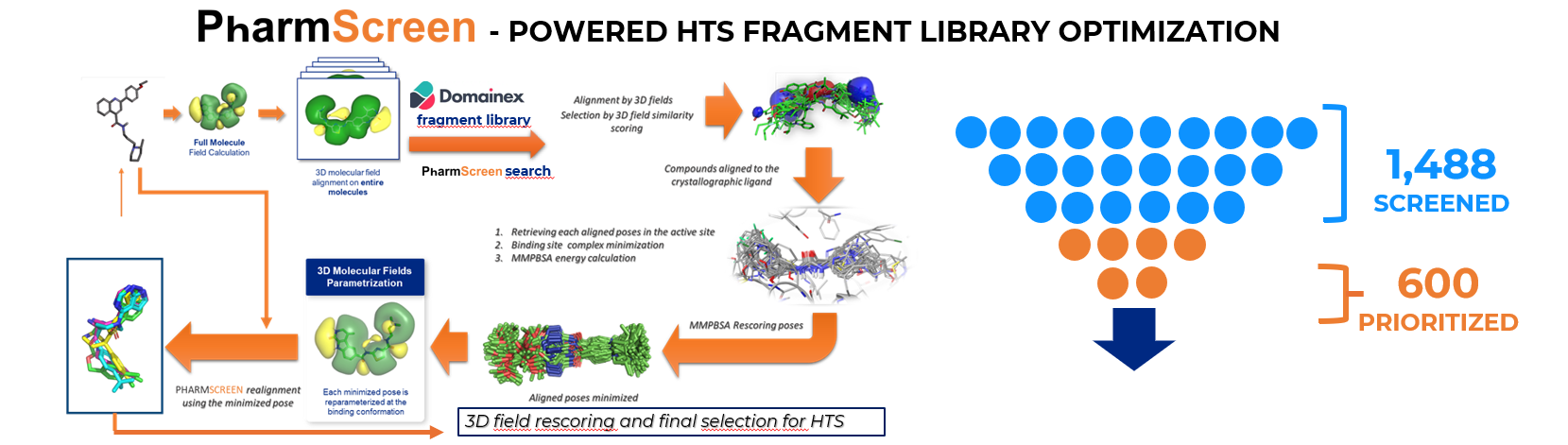
PharmScreen®-powered virtual screening pipeline and fragment library prioritization funnel (1,488 → 600 fragments).
PharmScreen®’s 3D molecular-field engine narrowed the starting library from 1,488 fragments to 600 computationally prioritized candidates, concentrating experimental effort on the fragments most likely to bind, before a single assay was run.
- Full-molecule 3D field calculation and alignment across the entire Domainex fragment library using PharmScreen® search
- Compounds aligned to the crystallographic ligand and ranked by 3D field similarity scoring
- Aligned poses minimized in the binding site and rescored by MMPBSA energy calculation
- 3D molecular fields re-parametrized at the minimized binding conformation for a final PharmScreen® realignment and selection for screening
Stage 2 - Screen and Identify
Membrane nanodisc preparation · Biophysical screening · Hit identification
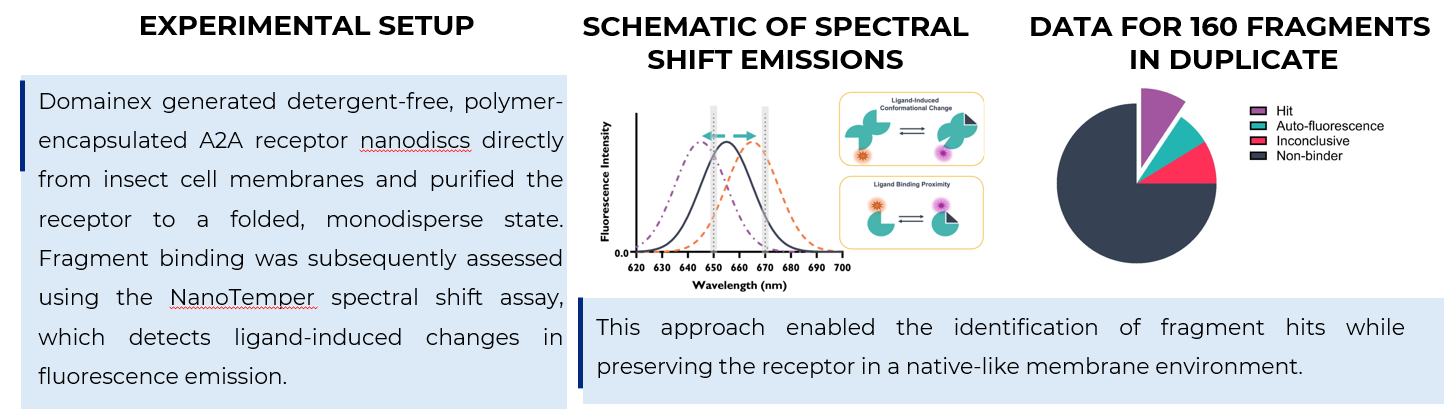
Domainex generated detergent-free, polymer-encapsulated A2A receptor nanodiscs directly from insect cell membranes and purified the receptor to a folded, monodisperse state. Fragment binding was subsequently assessed using the NanoTemper spectral shift assay, which detects ligand-induced changes in fluorescence emission.
This approach enabled the identification of fragment hits while preserving the receptor in a native-like membrane environment, addressing a common failure mode in GPCR fragment screening, where detergent solubilization can distort the binding site.
- Detergent-free, polymer-encapsulated A2A receptor nanodiscs generated directly from insect cell membranes and purified to a folded, monodisperse state (Domainex PureDiscTM platform)
- Fragment binding assessed via the NanoTemper spectral shift assay, which detects ligand-induced changes in fluorescence emission (through conformational change and ligand-binding proximity)
- Domainex fragment library was screened at a single concentration data collected in duplicate followed by concentration-response curves for the most promising hits to generate Kd values
- 80% of experimental fragment hits were observed within the PharmScreen® prioritised set, demonstrating the power of the technique to streamline libraries towards the target
Stage 3 - Design and Expand
Growth-vector analysis · Domainex D2B reaction rules · Plate-chemistry optimization · Compound filtering
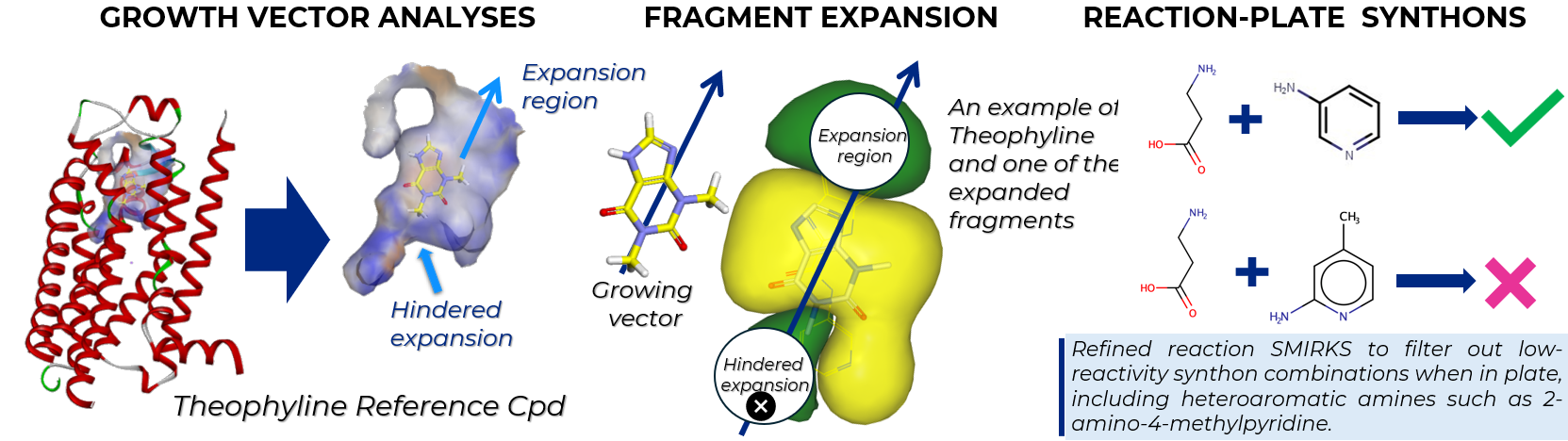
By encoding Domainex’s experimentally validated plate-chemistry reaction rules directly into the compound-design step, the workflow only proposed analogues that were both structurally promising and synthesizable in a single plate reaction — avoiding the common gap between virtual hit and makeable molecule.
- Growth-vector analysis around the theophylline reference compound identified accessible expansion regions versus sterically hindered directions in the A2A binding pocket
- Two fragment hits were chosen as scaffolds for D2B expansion – both displaying LE ~ 0.3 & kd ~10-30 μM
- exaScreen® proposed novel, reaction-ready analogues drawn from Domainex’s D2B reaction-plate synthon space
- Reaction SMIRKS were refined to exclude low-reactivity synthon combinations under plate conditions — for example, filtering out sterically hindered heteroaromatic amines such as 2-amino-4-methylpyridine, while retaining reactive alternatives such as 3-aminopyridine
Stage 4 - Make and Test
D2B synthesis · Spectral-shift screening · Binding affinity and ligand-efficiency analysis
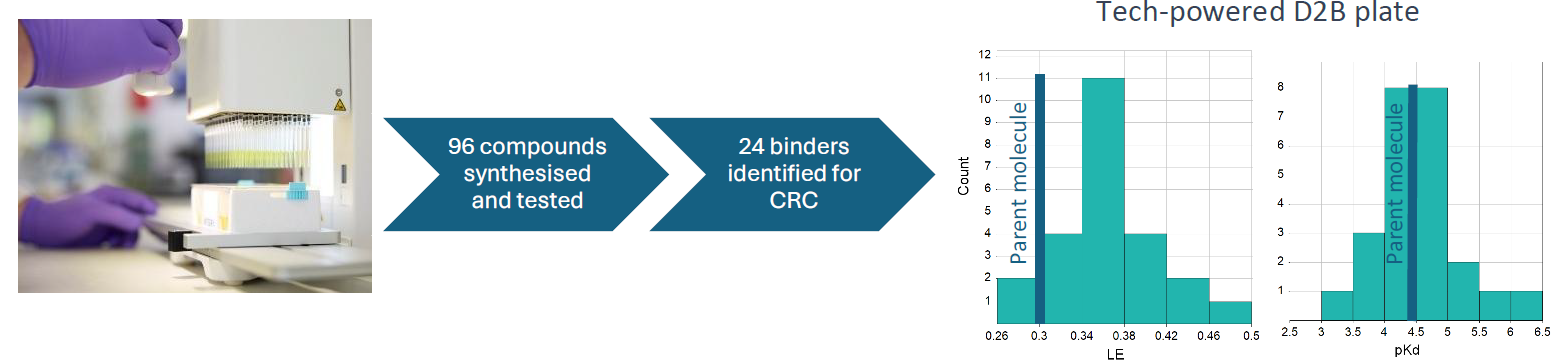
The D2B synthesis campaign was executed with exceptional speed, delivering 96 compounds within a 24-hour period and enabling rapid progression of the programme.
- The reaction-ready library was synthesized in Domainex’s Direct-to-Biology (D2B) format and screened by spectral shift without prior purification
- 96 compounds were screened at a single concentration followed by concentration-response curves (CRC) for the most promising hits (24) to generate binding affinity Kd and ligand efficiency (LE)
The tech-guided plate delivered an exceptional hit rate (25%), with a distribution shifted toward improved ligand efficiency and generating a new lead molecule with 100-fold improved binding affinity — direct evidence that reaction-aware computational design translated into better molecules at the bench, not just on screen.
Results & Key Takeaways
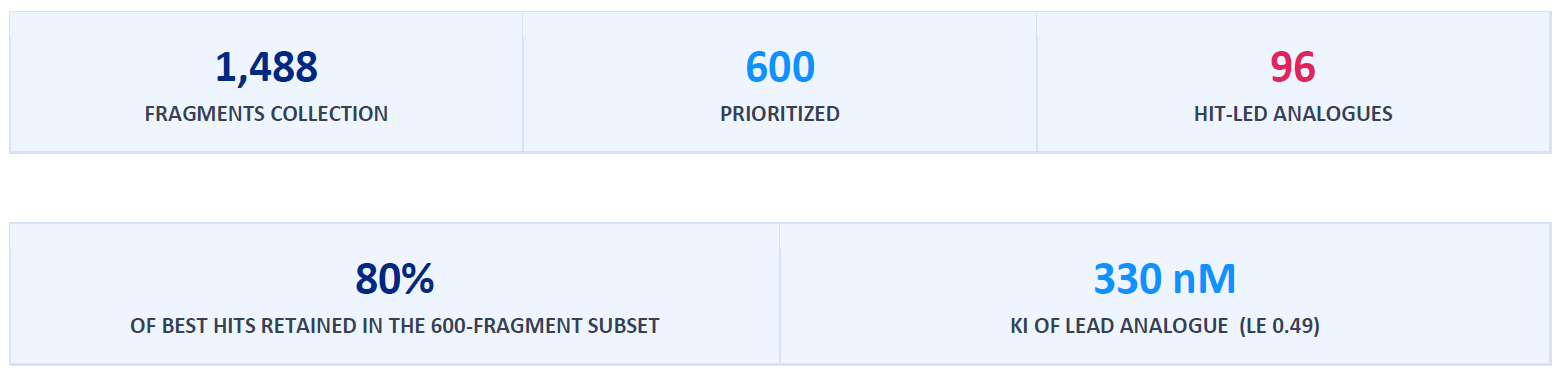
- PharmScreen® reduced the initial 1,488-fragment library to 600 prioritized compounds, while still retaining 80% of the experimental fragment hits, demonstrating efficient enrichment of likely binders before screening.
- Domainex PureDiscTM platform enabled fragment screening in a native-like membrane environment, helping identify hits while avoiding potential artefacts associated with detergent-solubilized GPCRs.
- A reaction-aware workflow generated 96 synthesis-ready analogues from validated D2B chemistry rules, ensuring compounds were both biologically promising and compatible with rapid plate-based synthesis.
- The D2B campaign delivered 96 compounds in 24 hours, achieving a 25% hit rate and a ~100-fold potency improvement in a single expansion round.
From Study Proof to Next-Campaign Value
Beyond the A2A results themselves, the workflow is designed to compound in value across a discovery programme: evidence from one screening round directly sharpens the design of the next.
| Step | Study Proof | Next-Campaign Value |
|---|---|---|
| 01 | Known hits retained in the 600-fragment subset | Prioritize fewer fragments before experimental screening |
| 02 | A2A receptor nanodiscs utilised in Spectral Shift assay | Domainex PureDiscTM platform can provide high-quality membrane protein suitable for multiple assay formats |
| 03 | Known fragments reveal growth directions around theophylline | exaScreen® suggests unseen, reaction-ready-by-plate fragments (new chemistry) |
| 04 | 100s of targeted analogues synthesised in 1 FTE day | Rapid exploration of vectors to yield potent, efficient leads |
Conclusion
This case study demonstrates that a reaction-aware fragment-expansion workflow, pairing Pharmacelera’s PharmScreen® and exaScreen® 3D-field computational platforms with Domainex’s Direct-to-Biology plate chemistry, can materially improve both the efficiency and the chemical diversity of a fragment-to-hit campaign. By filtering for plate-compatible reaction chemistry before compounds are ever proposed, the workflow closed the gap between computational design and synthesizable, testable molecules, while preserving the A2A receptor in a native membrane-like environment throughout screening.
Because the underlying method is target-agnostic: built on general 3D molecular-field alignment, scaffold hopping and reaction-rule filtering rather than A2A-specific assumptions: this workflow can be applied to find novel, potent, synthesizable hits for any target of interest.
Activity co-financed by the European Regional Development Fund (ERDF).

Parc Científic de Barcelona (PCB), 08028 Barcelona, Spain contact@pharmacelera.com · www.pharmacelera.com
Start your next project with Domainex
Contact one of our experts today